
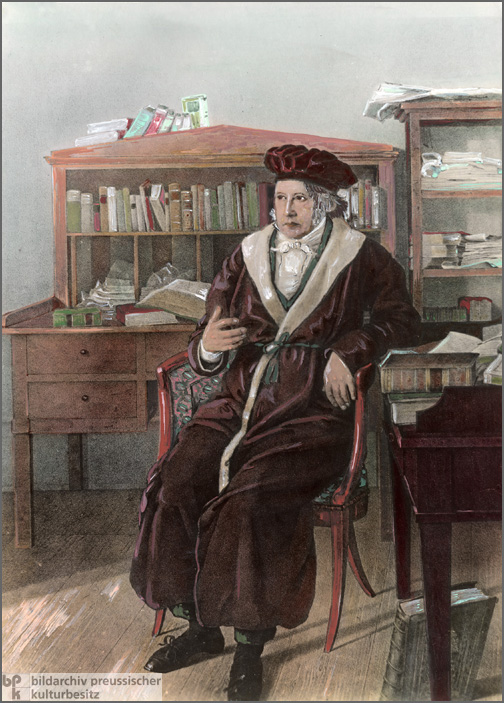
 This post began as a response to Julia Thornton's brief comment on a previous post in which I outed myself as a fan of the philosopher Hegel, directing me to a site where Hegelians roamed free. It's an interesting thing what we make of what we learn at uni - and to some extent maintain beyond it with a bit of reading. Outside one's field, one can't take too deep an interest in a particular area - or it's practically very hard. So what does one take into life outside the field one might follow? An ossified set of propositions from some old codger. Well perhaps. For me anyway, I can say that my study of Hegel helped shape a few important things about my intellectual orientation to things.
I doubt it really changed me (for good or ill, these things are largely temperamental I suspect) but it gave me a bit of a vocabulary to express some things. And as I said in the comment to Julia, "the thing is, I'm not a Hegelian. I'm not an anything much."
I think Hegel is the most amazing, eye-opening philosopher I've ever come across, and I think of his ideas a lot, but I don't think they create a program for anything much - or at least not for me. My own idea of philosophy is that it's a kind of 'rhetoric of epistemology'. If, as is likely that means nothing to you I'll try to explain - though who knows how I'll go, it's quite tricky to explain.
Since we don't have a clue what makes up the world, or how we should think, the thing I love about Hegel is that he reinvents the world in a fabulously rich way. I divide philosophy and those who discuss philosophy into two camps. The first lot fancy themselves as devilishly commonsensical and they're forever lecturing us that if only we could jolly well sort ourselves out, then we could cure the world of all known diseases march down the road to truth, principally by eliminating error.
Logical Positivism was in this tradition. And, in reinventing 'Hume's fork' - in saying that something was either falsifiable or meaningless metaphysics - they didn't quite account for the fact that this linchpin of their system, their criterion of meaningfulness itself was unfalsifiable and therefore (presumably) meaningless. To me Logical Positivism is the philosophical equivalent of the Titanic - the unsinkable ship, sinking on its maiden voyage. Richard Dawkins - purveyor du jour of schoolboy atheism - is the amateur philosopher in this mould, unaware of his own capacious ignorance of the very topic on which he writes whole books. I call this philosophy as 'metaphysics by default'. The practitioners do metaphysics but are unaware of the fact, thinking it's commonsense. In this sense they are deliciously unphilosophical, but blissfully unaware of it as they troop on through the undergrowth, pith helmets firmly strapped to their chins.
In this world of thought, categories like 'matter' or (though this is a bit out of fashion) 'mind' lurk either explicitly acknowledged or as implicitly fundamental categories on which thought gets built. But no-one has got the foggiest clue what 'matter' or 'mind' really are. (Paradoxically they've got a pretty good idea of what 'mind' is because they experience it from the inside, but they can't escape the subjectivity of that experience. As for matter, well, even as a scientific endeavour, the more we look into it the more its intelligibility recedes from us. It gets curiouser and curiouser.)
My own personal conclusion from this is, as I've suggested on this blog before, is that if we go looking for foundations for our thought, we end up in fictions. It's best we acknowledge that and since they're fictive, we get the opportunity to make up fertile fictions - fictions which will help us think in a fruitful way rather than just lead us to rehearse what seems obvious to our senses (but which is in fact the quite arbitrary artefact of our intuitions as beings which inhabit a largely 'Newtoninan' world between galactic and atomic scales.)
Hegel of course is consciously anti-foundational. And he does a phenomenal job of that (oops on a re-read I just realised that's a pun - which I'll stick with). Picking up The Phenomenology of Spirit and starting at the Prologue is a giddying experience. It explains that it's not really a prologue, that it can't really set out its argument in advance, that a later argument disagreeing with an earlier argument does not refute it, any more than the flower refutes the bud from which it has grown.
But, though it does some violence to his language and thought, you could put it differently so as to juxtapose what I've called 'metaphysics by default' with Hegel's approach - which I'd call 'metaphysics by design'. You'd say that Hegel's 'foundation' is that the world is the emanation of 'spirit', which of course his philosophy is then consumed in dramatising.
What is 'spirit'? Well, who knows? But then remember, no-one escapes from the ridiculousness of opening their mouth. Certainly not materialists. We have no idea what 'matter' is, nor 'mind' except in a hopelessly impossible to communicate subjectivity. And it turns out that, in Hegel's hands, his fictions acquire a coherence and a power as one comes to understand how he explicates it. It really does give you new eyes with which to see the world. And so one's understanding of one's human situation is built up from a fertile fiction, rather than deduced from a lifeless and obvious fact, which, on a little serious thought turns out to be made up - that we and the universe of which we are a part are made of 'matter' - whatever that is. Oh – and space and extension – whatever they are.
But to be an Hegelian one would presumably buy into Hegel's schema in some committed way - one would accept some Hegelian dogma. I'm afraid that while I think of Hegel's system as the most brilliant piece of fictive foundations or protocols for epistemology and ontology I've encountered, that's all it is. A particular and incredibly fertile endeavour by one of the great philosophers of all time.
My sympathy for religion, which I suspect mystifies and irritates a few Troppodillians, is made of the same stuff. Religion is built on fictive foundations which are a human construct (fictive foundations on which many modern, and some less modern believers understand to be a human construct). And yet, as with Hegel's system, and unlike more mundane 'materialist' understandings of the universe, the strangeness of the fictive foundations of religion are an invitation to continual renewal in helping us interpret our changing experience in the world.
You're not a Hegelian because it sounds like you're more an Pragmatist or a Quinean.
You might like John Dewey, who is a Pragmatist heavily influenced by Hegel and an avowed anti-foundationalist, but not the guy who invented the Dewey Decimal System (that was Melvil Dewey -- who was not only a segregator of non-fiction books, but a racist segregator of people too).
Yep - pragmatist, that's me. The one post-Hegelian philosophical system that's pretty low key and commonsensical. I should have said that in the post.
I'm a big fan of Dewey. (And Peirce though he's a bit over my head.)
I never quite understood why we needed Popper's theory of science after the pragmatists. Peter Singer has a good article arguing that Popper's intolerance of Hegel was kind of odd given that Popper's and Hegel's theories of science are pretty similar.
So I wonder what an actual Hegelian would look like? Presumably as beset by cognitive dissonance as the rest of us. Accepting a philosophical position does not necessarily mean to be dogmatic. It can also mean subscribing to an orientation. While this observation runs the risk of repeating many of the arguments already run in the Troppo post of May 26th on Belief
I think how we think about things is at least as important if not more important than what we think.
Habermas held that there were only three possible ‘hows’, technical practical and emancipatory. (I think he might have been borrowing from Aristotle). To my mind there might be a fourth which is something like ‘understanding’ (the sociological verstehende). This is not a direct intersection between thinking and how things happen which Habermas’s three are, but a way of standing back and going Ah, which precedes these three. Being aware that one is first of all orienting oneself is a good idea. Knowing that that initial orientation is not specifically logical helps. For example, how do we choose what to pay attention to? Is there a ‘positivist’ way to choose a problem to work on? You might if you were a positivist say 'I looked through all the journals and decided that this issue had not been dealt with', but is there an actual logical methodology for deciding it is ‘interesting’ and not just absent?
Further, can we get away from “fictive” foundational thinking as a basis for subsequent interpretation? Whether it is religion, fundamentalist atheism, (Dawkins) or ism’s like Marxism, feminism, free market economics, public choice theory-ism and so on, or non ideological beliefs – eg from the May 26th blog comments – that we remain the same person from one year to the next; I think not. We are constrained by a need for internal coherence which keeps the content of belief systems relatively tidy and a preference for excluded middles which keeps them relatively separate. There is a bit of a space premium caused by limitations on working memory (See 'The Magical Number Seven Plus or Minus Two' a ground breaker) which means that beliefs are compressions, but not of “information” unless you subscribe to the computer analogy for brains. They are compressions of lived experience and interpretations of those lived experiences, our own, and those received from around us. They are the “frame” of our lifeworld. Stephen Rose (The Making of Memory) points out that emotion makes memory stronger (p 331) which helps explain some aspects of the gritty determination of the dogmatic, and he also emphasises the phenomenological quality, the subjective reality of recollection.
(p377) It is the quality of recollection necessarily being of ‘things in relation to each other’ that for me makes beliefs, ideologies, paradigms or foundational thinking – all the same thing really – unavoidable.And I think there is some point in your philosophy making you who you are. Paying attention to what you believe and knowing it is a belief and refining it and using it as an ethical basis even if the philosophy is 'understanding' makes you more coherent and trustworthy to yourself and to those around you.
PS Re accompanying picture of Hegel; that's what I wear when I am writing!
I just found a nice quote by Martin Amis, addressed admiringly but in remonstrance to his friend, the militant atheist Christopher Hitchins.
It seems to me the sure sign of a philosophical bullshitter is that in order to close their argument satisfactorily, they have to give perfectly useful terms like "higher intelligence" a new and useless sense.
Just to clarify, the bullshitter is Amis, not Nick.
Note: this from Kevin Kelly is a 'scientific' appreciation of anti-foundationalism
Is this the Parmedian paradox being discussed.. that something cannot come of nothing, must always have been there yet where did it come from?
It seems difficult for me to reconcile modern physics, even to do with energy/ matter interfacing, with it- doh!
Just ran into this quote from Georg Brandes (not, presumably a relation of our own philosopher in residence for the government) a nineteenth century philosopher about Hegel's system:
Well ..
After reading through
all the torturous stuff and nonsense above ..
Let's let Socrates have the last word . .
"The only thing I now
for sure
is that I know nothing for sure .. "
The great Dewey's first published paper was The Metaphysics of Materialism, which is well worth a read in this context.
Jordan Peterson raises a lot of similar issues – in his usual intense way – in this video which I recommend.
https://www.youtube.com/watch?v=dfvVu7__vy0
Also, this is a terrific exploration of what I call metaphysics by default.
Having defined the phrase, "metaphysics by default" differently, I can appreciate your use of the phrase, while seeing something else. Understandably, you see a certain "fiction" behind the metaphysical thoughts of logical positivists - and all others, without exception?
But what do I see? As in the old essay, I see at least one useful approach to ontology of subjective continuity - a charged aspect of "metaphysics". Arguably, the functional presentation required no fictive element; no suspension of disbelief, meaningless term, or mere poetry.
This metaphysical reasoning is not entirely certain - what metaphysical reasoning is? - but I think it avoids such common failing of casual metaphysical text.
I see this much in the essay, as do a few other authors and correspondents.
What do you see?
Rereading this, I noticed an odd error which you might want to correct: Falsifiability was proposed (by Karl Popper) in *opposition* to logical positivism, not in support of it or as its core tenet. - Logical positivism wants scientific statements to be empirically verified by evidence. - But falsifiability wants scientific statements simply to be in a form where they are open to refutation. Popper's falsifiability eventually replaced logical positivism's verification as the criterion for "scientific" hypotheses. As you can guess, I still think it holds the primary place as a useful divider of the scientific from the pseudoscientific. Logical positivists wanted a science that proves truth. Popper wanted a more humble criterion that reminds us we can never be 100% sure, but encourages us both to come up with promising but falsifiable theories and then work hard to see if we can falsify them.
Thanks David,
You're quite right - the LPs oriented their critique of nonsense around empirical verifiability not falsifiability.
Still, I see Popper as essentially trying to save the LPs project. He did so with two tactical retreats. By not taking on metaphysics and so, moving the demarcation question from sense/nonsense to science/pseudoscience and from verification to falsification.
This made Popper's strictures much hardier, though their popularity these days is largely among scientists - particularly popularisers of science. Not that that would be enough to bother me. Without the context I'd probably be taking it as a plus :)
For me however Popper and the LPs were basically barking up the wrong tree. They want some explicit, legislated demarcation which seems kind of immature and impatient. Could one come up with some simple demarcation that would tell you the essential difference between a good person and a bad one, a beautiful painting from a bad one, or to stretch things further, how we recognise a face? I find Michael Polanyi's ideas more helpful. As you know, he thinks of science as a highly complex acculturated performance which is imersed in both ethics and aesthetics and tries to offer some commentary from there.
Thanks W Stewart. I must have missed your comment when you made it. I had a poke around at your site, and went to Chapter 18 as you suggested. Noetic reduction threw me rather, and I didn't get to the end alas.