
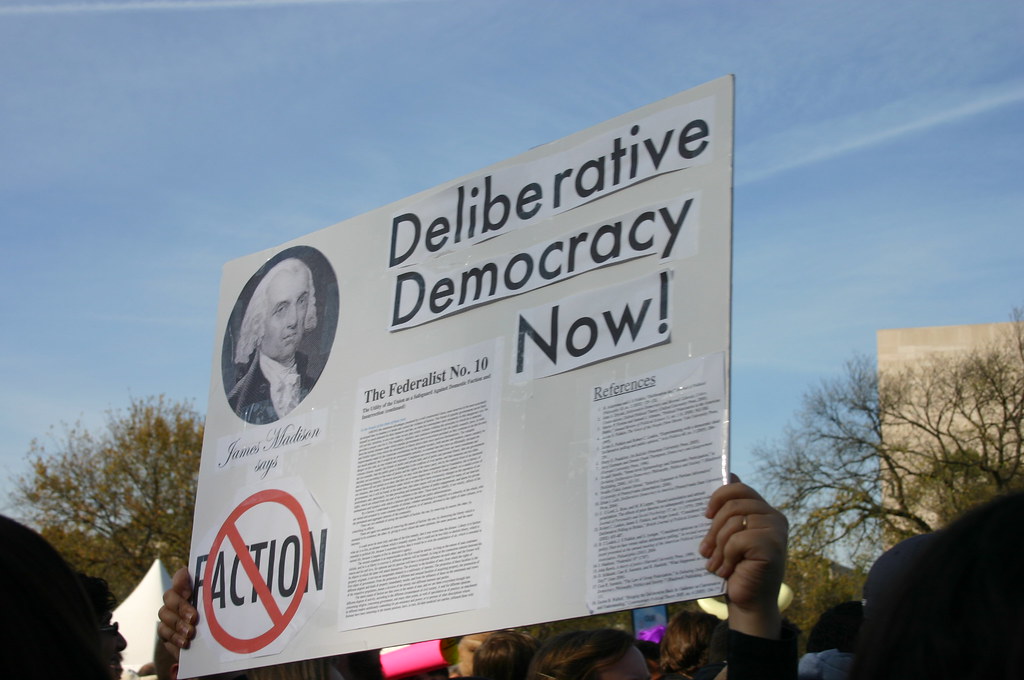
 What do we want? Deliberative democracy! When do we want it? NOW!!
This story from this larger study speaks for itself, but is illustrative of some of the themes of my previous post on deliberative democracy.
In the spring of 2004 we began work on a citizens’ jury process that we co-designed with the residents of a town in northern England. One third of its population is minority ethno-cultural heritage communities. The subject of this ‘doit-yourself jury’ was to be decided by the twenty volunteers, drawn at random from community organisations and the electoral roll.
At the end of a day-long workshop, the jurors settled on the role of the police relating to drink and illegal drug use among young people. This topic made local politicians nervous, they asked that we postpone the jury until after the local elections in a few months’ time. They refused to provide information to the process or cooperate with it.
Having heard a wide range of perspectives from a diverse set of ‘witnesses’ the jury sought to recommend a number of solutions to the problems highlighted during the process. The jury at no point divided along ethnic lines. The following is an extract from our 2004 report about the process:
We observed that white residents living in areas of diverse ethno-heritage often feel patronised by conventional anti-racism campaigns. Such messages are promoted by the same authorities who seem to have failed to address some of the most urgent problems facing their communities.
Our final report suggested that some Asian and other minority communities might welcome a re-direction of resources towards initiatives that allow them to join together with white community members and bring pressure for change, especially since many of the most pressing social and economic problems affect all the local population regardless of their background.
We suggest that the re-building of democratic engagement in northern England, as in many other parts of the UK, will be greatly enhanced by an increase of face-toface meetings such as those that form the essence of a do-it-yourself citizens’ jury. However, such exercises are only likely to be successful when they involve a broad range of local community groups and are not controlled by any one stakeholder or funder.
Though the jury presented their report in person to the council leader, a member of the European Parliament and opposition politicians, the council studiously ignored the process, both before and after the election. As organisers and facilitators we and the jurors fundraised for ongoing activities by ourselves, including a stall at the local market. But without the backing of a strong campaigning organisation, our impact on the way in which the local council consulted its population was minimal.
The funder of the jury, a well known UK grant-making foundation, was extremely sympathetic to the jury’s desire to make their local council more accountable. They even attended meetings at which council officials expressed interest in working with the jurors. But four years later, jurors have had no contact from the council and have become sceptical that the council has any intention of working with them.
On reflection, we as organisers recognise at least two mistakes we made that allowed the council to domesticate the jury process, even though it was independent of them. Firstly, we underestimated the power of the local council to marginalise the process. By parachuting into a complex local community and organising a process without it being jointly owned and planned by accountable community organisations that had legitimacy with the council, it was easy for senior local policy makers to portray the jury as troublemakers.
Secondly, we wrongly expected that the multi-racial group of individuals that emerged from the jury process would be empowered enough to become activists in their own right, supported by an infrastructure that could easily be organised remotely from outside the region. In reality, the community empowerment our project envisaged required long-term investment in grassroots community work. Despite modest ongoing support from an extremely patient funder we have not yet found a formula that allows us to overcome the suppression of our alternative to the ‘pork barrel’ politics that dominates the dysfunctional government of an economically deprived town.
There's good and bad:
- the juries got shafted, which is a shame and was likely welfare-reducing
- the large grant foundation may now be ready to actually try and help people improve their lives as opposed to just "parachute in" and tell them what they need..
Silver linings ;)
Oops. Would you mind deleting if possible that comment?