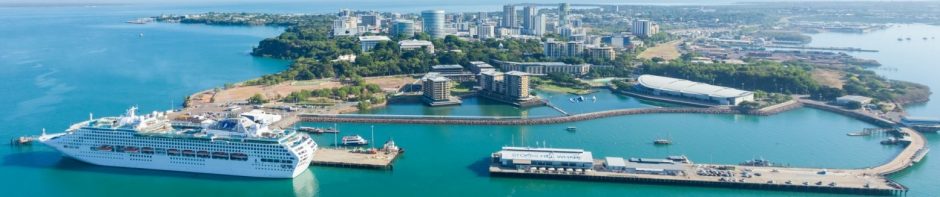
Well, here you are at the capacious new premises of Club Troppo (formerly Troppo Armadillo ). Just about all the grunt, grind and skill involved in creating this shiny revamped WordPress blog has been contributed by the amazing (and amazingly patient) Stephen Bounds. We are de...
Continue reading →
This week's column - with the answer to the question about the picture below. And I hope Troppodillians had an enjoyable Christmas. Some Christmas reflections ________________________________________________________________ I'm afraid (but not ashamed) to say that I'm an abste...
Continue reading →
All will be revealed on Tuesday night.
Continue reading →
I thought this was a teriffic op ed on the Cronulla riots. It's got a 'down the middle' format that many Troppodillians will know that I'm attracted to. But I think the points it makes about the standard left and right views of the issue are spot on. I would have liked to have...
Continue reading →
This is a quote from a sympathetic review of a book I am reading called "Children of the Lucky Country". I hope to write more on it soon. Paul Kelly - (not the journalist but the board member of the Australian Research Alliance for Children and Youth) writes this: Australian p...
Continue reading →
I've previously written up the idea of charitable giving at Christmas. It's a bit late now I guess, but, in doing some reading around for next week's column I came upon an Australia Institute paper (pdf) that I'd missed on Christmas giving. It gives a bunch of links to Christm...
Continue reading →
In 1959 Michael Harrington shocked America with the claim that 50 million of its citizens were living in poverty. His magazine article turned into a book and by 1964 President Johnson was standing outside a shack in Kentucky announcing that the nation was at war with poverty....
Continue reading →
At the end of each year, like migratory birds, the world's international greenhouse diplomats over ten thousand of them hear a mysterious call. And each year the tell-tale trails of greenhouse gas seem to stretch yet further across the sky as planes descend on another exotic l...
Continue reading →
I've found from long experience that if you don't promote yourself no-one else is likely to do it for you. So it is with great pleasure that I note Troppo has been awarded the gong by Crikey as it's Best Blog of the Year . I'm usually not a great believer in awards, especially...
Continue reading →
I've just been to see the above film and recommend it. It seems to have a fair bit of verisimilitude. For those that don't know, it's about the role of CBS news and what we now call 'current affairs' in the downfall of Joe McCarthy. At a time when people are being deported fro...
Continue reading →
George Monbiot agrees with the Australia Institute, though he calls a spade a spade and comes out and says it. Whereas the Australia Institute hates four wheel drivers but dresses it up in all sorts of apparently reasonable and scientific talk, George just gets things off his...
Continue reading →
I regret to say that the standard bearers of open source on your desktop, Firefox browser and OpenOffice.org both have important flaws. Firefox has dreadful memory hunger. Have a look at how it's chewing up resources on my own system (above) though I guess I can forgive it it'...
Continue reading →
Robert Carter is the President of the Australian Society of Marine Artists. He has some paintings on show at the Mosman Art Gallery, alongside a truly spectacular selection of important works collected by Howard Hinton and donated to the Armidale Teachers College. Anyone who t...
Continue reading →
Let me count the ways. 1. Platinum Capital doesn't pay investment 'advisors' to recommend its product. 2. It doesn't 'index hug' but rather tries to make money as well as it can using a range of strategies that are broadly contrarian. Thus rather than hedge currencies in a mec...
Continue reading →
(1) It's all down to the cunning evil racist manipulator HoWARd, who used his mincing minion Jonesy to inflame the ignorant, white bogan surfie meathead masses into a jingoistic frenzy against some basically harmless colourful ethnic oppressed yoofs. (2) It's all the fault of...
Continue reading →
One of my relatives, just retired, has a serious and longstanding weight problem, complicated by a bad leg as a result of a car accident many years ago. One leg is shorter than the other (which could have been corrected by a built-up shoe) and that has upset her gait and damag...
Continue reading →
Albert Jacka was possibly the outstanding footsoldier and front-line leader of men in the Great War. It is possible to imagine equally impressive achievements but hard to imagine better. That is a big claim, but check out the record . It is worth reading to the end because Jac...
Continue reading →
Jen often wants me to tell her a story. But it isn't that easy. I'm not one of those blokes who can spin a yarn at the drop of a hat or even talk the legs off an iron pot (how's that for a mixed metaphor?). The mood has to be right and the muse suitably inspired. The Harbord D...
Continue reading →
"Isolated and angry" an apt descriptor of Far South Sydney's [pen]insular white trash? Err, no it actually refers to residents of geographical middle Sydney. Of course, The Australian 's headline is meant to refer to cultural, rather than geographical isolation. But other tha...
Continue reading →
This week's column. My father sometimes responded to my cheekier moments with an old Jewish saying that greatly amused him "If you're so smart, how come you're not rich?" Dad dedicated his own smarts to academia, and was happy with the tradeoff he made in favour of interestin...
Continue reading →
Families surround us with symmetry. Echoes. Half-understood parallels. You realise it more and more as you get older. Like when you rebuke your child for some appalling piece of behaviour, and suddenly realise you're using the same words and tone your own parents employed when...
Continue reading →
Meet Didius Julianus I've been listening to some introductory lectures on the Byzantine Empire . A nice fact I didn't know is that those Romans were way ahead of us economists in the use of economic instruments. Didius Julianus was a little too short term in his thinking. Afte...
Continue reading →
My last trip to bed with a nasty wog brought forth a feast for those Troppodillians who were interested. Some gems from hours of listening to Radio National were unearthed. Well, I've got the dreaded virus again, and expect to recover in the not too distant. In the meantime th...
Continue reading →
I've got a bunch of correspondence from charities I give to. I'm not a close observer of these things but I guess their main times of the year are Christmas time and end of tax year time. Anyway, they've been busy with their direct marketing techniques (and I suspect receiving...
Continue reading →
My editor asked me to write about the Robert Gerard scandal, so I did reflecting on some broader governance issues. Readers with an eye for some of the economic debates will detect in the background of the second half of the column the debate on Reserve Bank independence. As t...
Continue reading →
Brian Penton's book The Landtakers is now on line as a part of the Australian Gutenberg ebook project. It came up when I did a google on Jacques Kahane who worked with Penton to translate Mises "Against Socialism". Penton's novel is dedicated to Kahane. Similarly, Olga Penton'...
Continue reading →
From today's Financial Review You can tell when governments get long in the tooth: ministers keep recounting the good old days, when they first came to power. So it was last week when the leader of the government in the Senate, Senator Robert Hill, gave one of the reasons for...
Continue reading →
Congratulations from all right thinking people to Steve Bracks' Government in Victoria. We'll be accompanying our daughter Anna to the Children's Hospital for her to participate in a ballet concert for the entertainment of the kids in the hospital as they battle various ailmen...
Continue reading →
Some Troppodillians might have heard the essay I posted on Troppo a few months back on Oscar Wilde and Ned Kelly boiled down into a five minute talk. 1 For those who are interested, the transcript is below the fold and you can even download an MP3 of the broadcast [4.8 Megs]....
Continue reading →
Sixty percent of a rabbit's meat is in its hind legs. That's why it's so difficult to make one rabbit into a meal for four people. If you need some ideas on how to do it, then Anthony Georgeff's Spiceblog is the place for you. Georgeff's blog has the most amazing food pictures...
Continue reading →